Not all storage cabinets can accommodate all storage needs. Understanding how to match the interior to what it holds prevents wasted space, unnecessary expense, and frustration later.
By Chad Haas, ASID · VAULT Custom Garage Design
Most garage cabinets with doors are designed around one assumption: everything will sit neatly on a shelf. That works for storage containers, boxes, paint, extension cords, and bulk household supplies.
But not everything stored in a garage is shaped that way. Golf clubs, skis, rakes, shovels, hockey sticks, leaf blowers, and riding jackets are tall, awkward, and often different lengths. Standard shelving is not designed to accommodate them very well.
While full-length shelves are the standard for many storage cabinets, they cannot correct a cabinet designed around the wrong type of storage. Planning for these items beforehand can prevent wasted space, unnecessary expense, and frustration later.
This article looks at why standard tall cabinets struggle with vertical items, what that costs in usable storage, and how a segmented interior changes the way the space works. If you have ever stood in front of a full cabinet frustrated that some things will not fit, the problem is usually not the amount of space. It is how the space is divided.
Before selecting a cabinet, the first step is deciding what belongs on shelves and what requires uninterrupted vertical space.
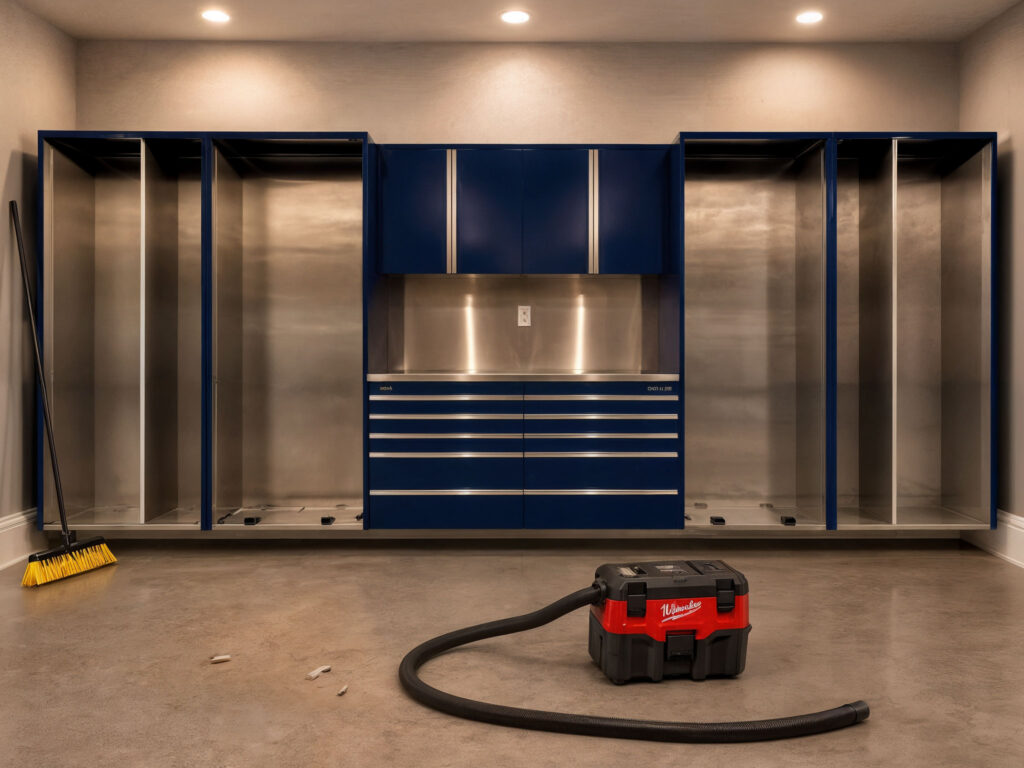
A fully segmented armoire in brushed stainless steel, showing the center divider that separates open vertical storage from adjustable shelving. This configuration allows tall equipment, shelved items, and hanging gear to occupy the same cabinet without compromise.
The Challenge with Full-Length Shelves
A broom illustrates the problem.
A broom requires nearly the full height of a cabinet, but very little of its width. In a cabinet fitted only with full-width shelves, several shelves must be removed to accommodate it. The space beside the broom can hold other tall items, but the cabinet can no longer use that same area for shelved storage.
Full-width shelves force a choice: keep the shelves and exclude tall items, or remove the shelves and surrender usable space above shorter items. Golf clubs, skis, fishing rods, hockey sticks, and garden tools create the same conflict. They need height, but they rarely need the full width of the cabinet.
That is how dead space is created. The cabinet may have volume, but the interior does not provide a practical way to use it.
A segmented interior divides the cabinet vertically. One section remains open for tall equipment, while the other retains adjustable shelving. The cabinet is not necessarily larger. Its interior is simply divided according to what needs to be stored.
Start With What the Cabinet Needs to Hold
The most important decision is not the cabinet size. It is what the cabinet needs to hold.
Before choosing an interior layout, take inventory of the items that are usually left out in the open. The goal is not to count objects. The goal is to understand their shape.
Some items need uninterrupted height. Some need shelves. Some need to hang. Some need to be easy to reach because they are used often. Once those differences are understood, the cabinet can be planned around them.
This is how storage becomes cleaner and more useful. Instead of relying on hooks or slatwall, which keep objects visible and can make a garage look busy, more of those items can be stored behind doors.
A good start to each project begins with a simple question: what should be stored out of sight, and what type of space does each item require?
Sporting Goods
Sports equipment often creates the same storage problem in different forms. It may be long, narrow, grouped in sets, or paired with smaller accessories that need to stay nearby.
A standard cabinet with full-width shelves forces the owner to remove shelves entirely or keep the shelves and store the equipment out in the open.
In a segmented armoire, sporting goods stand upright in the open section where they remain visible and accessible. A shelf positioned above them can capture the headroom for helmets, shoes, gloves, protective gear, or boxes of supplies.
Across the divider, additional adjustable shelves can hold bags, cases, and seasonal equipment at the spacing each item requires. The equipment stays organized inside the cabinet instead of being distributed across hooks, slatwall, and open floor space.
Gardening Equipment
Gardening equipment creates a similar problem. Long handles, varied widths, and irregular shapes make these items difficult to store on standard shelving.
Most end up leaning against exterior walls or lying on the floor, where they take up visual space and become an obstacle in the garage.
A segmented armoire gives long-handled tools a dedicated vertical section with full clearance. A shelf positioned above the tool heads can capture overhead space for hand tools, gloves, and smaller equipment.
The shelved side can hold fertilizer, soil amendments, pots, batteries, and supplies at the heights they require. What usually clutters the garage perimeter can be organized and concealed behind doors.
Conclusion: Plan Before You Build
The strongest storage starts with an audit.
Determine what is usually left out in the open. Identify which items need uninterrupted height, which need a rod for hanging, and which are better organized on shelves. Then plan the cabinet’s interior around those requirements before construction begins.
This prevents wasted space, unnecessary expense, and the frustration of a cabinet that does not quite work. It also keeps the garage cleaner and more composed because the things that normally end up on hooks, slatwall, or the floor can be stored inside.
Storage is not about maximizing density. It is about matching the interior to what it holds.
Lockers, Armoires, and Customized Interiors
Most manufacturers call these tall cabinets lockers. At VAULT, we build them as armoires because they are intended to feel more finished, more deliberate, and more connected to the room.
But the name is not the important part.
The important part is what happens behind the doors.
The segmented armoire was developed to solve a common storage problem: tall items and shelved items are often forced into the same interior, even though they require different kinds of space. When that happens, the cabinet may be large, but it is not as useful as it should be.
A segmented interior changes that. One section provides uninterrupted height for long equipment. The other section supports adjustable shelves for items better stored horizontally. A clothes rod can also be added when jackets, uniforms, or riding gear need to hang.
Because storage needs vary, VAULT builds the segmented armoire in different configurations. The open section can be placed on the left or right. Its width can be planned around the equipment being stored. Shelves adjust in half-inch increments, allowing the interior to be arranged with greater precision.
The right configuration comes from the audit. What needs height? What needs shelves? What needs to hang? What should be concealed behind doors instead of left on hooks, slatwall, or the garage floor?
That is the purpose of the segmented armoire. It is not simply a taller cabinet. It is a cabinet planned around the shape of what it holds.
Four Configuration Options
VAULT addresses this challenge with four configuration options for the segmented armoire. Each is designed to match different storage requirements.
The open section can be positioned on the left or right side of the cabinet, depending on what needs vertical clearance and which items require shelving. A clothes rod can be added to the open section when jackets, uniforms, or riding gear need to hang. Every shelf on both sides adjusts in half-inch increments, allowing the spacing to be configured precisely around the equipment being stored.
The configuration you choose depends on what the cabinet will hold and where each category of items should live. Planning that before the cabinet is built ensures the interior matches your equipment instead of forcing everything into a generic layout.
Option 1: Open left section with clothes rod and adjustable shelving on the right.
Option 2: Open right section with clothes rod and adjustable shelving on the left.
Option 3: Open left section for tall equipment with adjustable shelving beside it.
Option 4: Open right section for tall equipment with adjustable shelving beside it.
About the Author
Chad Haas is the founder of VAULT and the only interior designer credentialed by the American Society of Interior Designers (ASID) focused exclusively on luxury garage design. He has spent more than twenty years designing and furnishing high-end garages for homeowners, collectors, architects, and builders across the United States and Canada. VAULT is headquartered in Beaverton, Oregon, and serves clients worldwide.
Most garages in homes are designed last, finished cheaply, and never reconsidered. That is the mistake this guide exists to correct.
By Chad Haas, ASID · VAULT Custom Garage Design
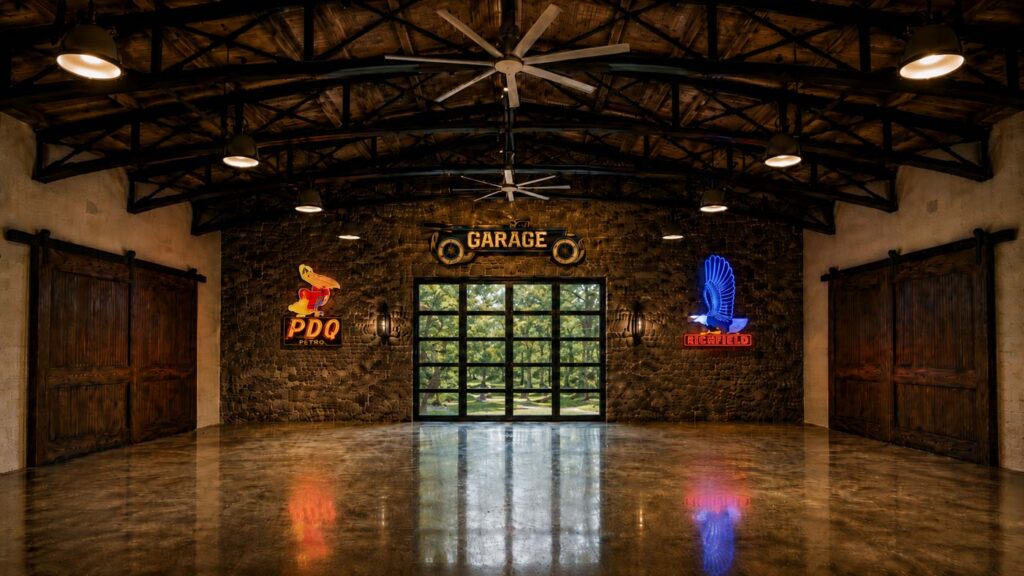
This is what a luxury garage looks like when every decision supports the next. Exposed steel trusses carry the ceiling. Black cabinetry anchors both walls. The floor reflects everything above it. Two carriage-style doors, centered and warm against white walls, close a room that earns the word finished. This is the standard the rest of this guide is written to.
A luxury garage is not a nicer version of an ordinary garage. It is a different kind of room, built to a different standard and asked to do different things. An ordinary garage asks how much it can hold. A luxury garage asks how it should feel to walk into, how the light falls across a car, how the floor will hold up fifteen years from now, and how the cabinetry contributes to the room rather than just its storage.
This guide is written for homeowners, architects, interior designers, and builders planning a garage that belongs beside the rest of a serious house. It covers the decisions that matter most: proportions, materials, systems, light, and cabinetry, along with the standards that separate a finished room from a storage space.
It is not a list of ideas. It is the framework we use on every VAULT project, brought together in one place.
More than that, it is a framework for making decisions. Every luxury garage is the result of hundreds of connected choices. Ceiling height affects lighting. Lighting changes how materials are perceived. Cabinet placement affects electrical planning, circulation, and how the vehicles are experienced in the room. Most expensive mistakes happen because those decisions were made separately, by different people, at different times, without anyone accountable for how they fit together. What people hire VAULT for goes beyond cabinetry. It is the judgment to make a hundred interconnected decisions that will still feel right twenty years from now.
That is where luxury garage design becomes its own discipline.
What Makes a Garage Luxury
The word “luxury” gets thrown around too easily in most product categories. Steel cabinets sold in flat-pack configurations are called luxury because the finish is powder-coated. A garage with a floor coating gets marketed as luxury because the surfaces are glossy. That is not what the word means.
A luxury garage is defined by three things, in this order.
First, the room is designed. A professional views the plan, thinks through the space, and draws it before anything is ordered. Every element answers to that plan. The room is curated to match the owner’s personality, needs, vehicles, habits, and aesthetic. It is not generically assembled from a catalog.
Second, the materials and systems are chosen for a service life measured in decades, not years. The floor, the cabinets, their hardware, the lighting, and the climate system all have to perform under the real conditions of a garage without losing their quality.
Third, the finished room reads as part of the house. Not as a pass-through. Not as a utility space. Not as a showroom set. As a room the owner wants to walk into and spend time in. It has architectural harmony with the rest of the house.
Those three bars form a simple test. Designed. Durable. Connected to the home. If a garage clears all three, the rest follows naturally. If it does not, no amount of upgraded flooring or branded cabinetry will make it a luxury garage. It will simply be a garage with nicer finishes.
Decision Principle
Luxury is not a product category. It is the result of good decisions made in the right order.
Start With the Program, Not the Products
Every serious garage project begins with a conversation about what the room is for. Not what it holds. What it is for.
A daily-driver garage serves one purpose. A seven-car collector room with a lift bay and a detail station serves another. A garage attached to an oceanfront home in a salt-air climate like Miami has constraints a garage in a Scottsdale compound does not.
That is the room’s intended use, and it should guide every decision that follows. Before the first finish is selected, a few key questions should already be answered.
How many vehicles will be displayed and stored here, and what are they? Daily drivers, collector cars, or both? Will the owner be working on cars, detailing them, or simply storing them? Will the owner have experts work on the cars in the space, such as professional detailers? Is this room accessed through the house, separately, or both? Is there a second function, such as a workshop, entertaining space, or gallery, and how should the room be laid out to support both uses? What is the climate, and what protection does that climate require?
Most homeowners think they are choosing cabinets, flooring, or lighting. They are not. They are deciding what kind of room they want to own for the next twenty or thirty years. Products are easy to replace. Ceiling height, circulation, electrical planning, wall construction, and the overall layout are not. The earlier those decisions are made thoughtfully, the fewer compromises the project requires later.
Knowing the program upfront prevents the most expensive mistake in custom garage design: approving a design and buying finishes before anyone knows what the room is supposed to do. More often than it should, a client will make a cabinet or floor decision too early, then discover later that it does not suit the architecture, the layout, or the way the room will actually be used. Those are expensive problems when they show up late, and simple conversations when they happen early.
Early planning also prevents a second common problem: utility systems located without coordination with the finished room. Electrical outlets placed where they will later be blocked by base cabinets, armoire cabinets, or wall cabinets. Water heaters, EV chargers, HVAC equipment, and irrigation controls installed wherever there is open wall space, with little regard for access, sightlines, or the overall composition of the room. In a serious garage, those decisions need to be planned, not randomly placed.
Another common mistake happens before the walls are even finished. If a foundation wall or curb is poured with a kick-out or projection, it can prevent cabinets from sitting flush against the wall. That affects not only the appearance of the installation, but the usable depth and planning of the entire run. It is a small construction detail that can create a major design problem later.
This is where a garage design specialist becomes most valuable to architects, interior designers, and builders. Involve the specialist during the design phase, before the slab is poured, the walls are closed, and the electrical is roughed in. Once those decisions are locked, the most important choices for the finished garage become corrections instead of plans, and corrections cost more.
Common Mistake
Choosing finishes before defining the program. A floor, cabinet system, or lighting plan cannot be judged properly until the room’s purpose is clear.
Proportions and Spatial Planning
The most overlooked part of luxury garage design is proportion. Most garages are built to code minimums and never reconsidered. A serious garage is built to the vehicles, the circulation, and the eye.
Proportion matters because the garage is not just a box that receives cars. It is a room that holds large sculptural objects. A car changes how the eye reads height, width, depth, and negative space. When the proportions are wrong, every other decision has to compensate. When they are right, the room feels calm before a single finish is selected.
Ceiling Height
Eight-foot ceilings are common in residential construction and usually too limiting for any garage that aspires to be more than storage. Ten feet is workable. For a collector garage or purpose-built workspace with lifts, a more reliable target is twelve feet, the minimum where the room begins to function properly, and fourteen feet is often the better target. A two-post or four-post lift that fully raises a vehicle for underbody work typically requires 12 to 14 feet of clear ceiling height. If the goal is vehicle stacking or greater clearance for trucks and SUVs, 14 to 16 feet or more is the right range. Lower ceilings also constrain the scale of display elements like neon or large-format art.
Ceiling height does more than accommodate lifts. It changes how a car sits in the room. A low ceiling compresses the space and makes the vehicle feel crowded. A taller ceiling lets the room breathe and allows the car to sit like an object in a gallery.
It is also one of the few decisions that cannot realistically be corrected after construction. Once the structure is built, a low ceiling becomes a permanent constraint that every other decision has to work around. That is why it belongs in the earliest planning conversations, before cabinetry, lighting, doors, or finish materials are finalized.
Decision Principle
The decisions that are hardest to change should be made earliest.
Garage Width, Access, and Clearance
Garage width should be planned around the actual vehicles, the cabinet depth, and how the room will be used once it is finished, not just whether two cars can technically fit inside.
An 18 to 20 foot interior width is a minimal fit and will feel tight for anything beyond two smaller vehicles. A 22 to 24 foot width is more comfortable and works for many two-car garages, especially where storage is limited to one side. If the room will have cabinet runs on both sides, 24 to 26 feet becomes the more appropriate range, with 26 feet preferred so doors, drawers, and people can move through the space without conflict. For luxury garages with larger vehicles, lifts, or a true work area, 26 to 30 feet or more is often the right answer.
The cleanest way to size the room is to start with the widest vehicles, including side mirrors, then add the depth of any cabinetry. Twenty-four inches is the industry standard for base and armoire cabinets. Then add the clearance needed for door swing: a 48-inch wide cabinet’s doors and drawers extend 24 inches into the room. Finally, account for movement along the walls and comfortable vehicle entry and exit.
A garage that technically fits two cars is not necessarily a well-planned garage. The room should still work once cabinet doors are open, car doors are fully swung, and people can move freely in the space. That is the difference between square footage and usable space.
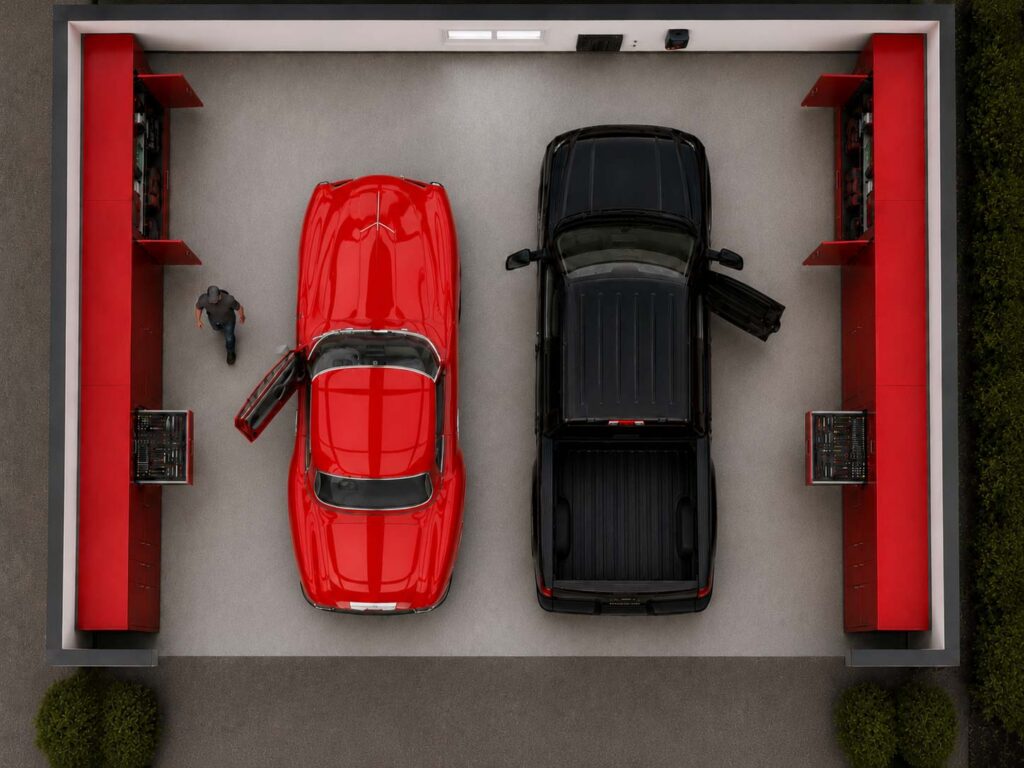
Garage width planning starts with what the room must do when it is in use, not just how many vehicles fit. This overhead view shows two vehicles with doors open, custom cabinets running both walls, and a person moving freely through the space. Usable width must account for vehicle size, cabinet depth, door swing on both cars and cabinets, and walking clearance, not simply whether two vehicles park inside.
Cabinet and Wall Planning
Cabinetry should be planned into the walls, not attached to them after the fact. A garage designed with cabinet runs, sink placement, countertop workspace, electrical locations, window heights, and tool storage considered during the architectural phase reads as a finished room.
One of the most common mistakes in a garage build-out is placing windows, outlets, and other wall elements wherever there is open space, without enough thought to how the room will actually function once cabinetry is installed. A window with a sill set below countertop height can interfere with a cabinet run entirely. Electrical outlets are often placed too low, where they end up hidden behind base cabinets or inaccessible below the work surface. In a well-planned garage, outlets should be placed where they are actually needed, most often above countertop height for tools and battery chargers, and sometimes intentionally concealed behind a cabinet when a client wants to power something like a battery maintainer out of sight.
Storage planning matters just as much. The tools and equipment used most often should live where they are easiest to reach, near the main entrance, near the vehicle they serve, or close to a lift or work area. Good garage design is not just about fitting cabinets onto a wall. It is about placing storage, power, and work surfaces where they support the way the room will actually be used.
Common Mistake
Treating the cabinet plan as furniture placement. In a luxury garage, cabinetry is part of the architecture. If the walls, outlets, windows, and service elements are not coordinated early, the cabinetry will expose the weakness of the plan instead of completing it.
Materials and Finishes
The question clients ask, directly or indirectly, is always the same: is this quality? They ask it about floors, cabinets, doors, lighting, and nearly everything else. The answer is rarely found in a single specification. It comes from the combination of what material is best, how it was made, how it behaves over time, and whether it was chosen for the right reasons.
The Floor Is the Foundation
The floor is the largest surface in the room and, after cabinetry, is the second detail that tells whether the garage is finished or merely improved. That is why floor selection matters more than most people expect, and why it deserves a decision rather than a default.
Floor coatings have their place. Installed correctly, they can be economical, easy to clean, and practical. But a coating is still a coating. It sits on top of the slab, which leaves it vulnerable to delamination and discoloration over time. That gives it a shorter life than the alternatives because it is less durable than other floor treatments.
The phrase that matters is “installed correctly,” because a floor is only as good as the substrate beneath it. A coating applied over a slab that has not been checked for moisture and cleared of oil, grease, and staining will not bond, and it will fail. The failure is invisible on the day of installation, which is what makes it so easy to get wrong. This is why VAULT does not specify coatings.
Large-format porcelain tile, properly specified and properly installed, gives the room a different character. Tile reads as permanent. It looks like architecture, and it connects the garage to the language of the house instead of isolating it as a utility space.
Format and thickness both matter. The larger the tile, the fewer the grout lines, and the more the floor reads as one continuous surface. We specify nothing smaller than 12 by 24 inches, and in rooms above roughly 500 square feet we move up to 24 by 24 or 24 by 48. For thickness, a 3/8-inch porcelain tile with proper abrasion and wear ratings is well suited to heavy residential use.
The one tradeoff to plan for is cleaning. Tile has to be cleaned with a porcelain tile cleaner rather than general-purpose products, and professionally machine-cleaned on a maintenance schedule to keep the finish at its best. In a collector or showpiece garage that is a small amount of added maintenance for the result, but it is worth understanding before you choose, not after.
Polished concrete sits at the top of our list. The process uses diamond-tooled machines that grind and refine the surface to the exact level of sheen you want. Three things put it at the top. It lasts, with a properly polished floor holding up longer than any other floor treatment. It offers almost unlimited color through staining, so the floor can be tuned to the room instead of chosen from a catalog. And it is genuinely easy to maintain, without the machine cleaning that tile requires.
There is one honest limitation. Polished concrete can become slippery when wet, so it favors a showroom or collector garage over a working space that is washed down often. The initial cost also runs higher than coatings or tile.
The real choice is not coating versus tile versus polished concrete. The real choice is whether the floor should behave like a utility surface or an architectural one. That answer depends on the room, the vehicles, the budget, and the standard of the home.
Polished concrete offers unlimited color through staining and holds up longer than any other floor treatment. It is the standard we specify most often in collector and showroom garages, where the floor is part of the composition, not just the surface beneath the vehicles.
Decision Principle
Choose the surface for the room you are building, not the product category you are familiar with.
Cabinet Construction
Cabinets in a luxury garage have a harder job than cabinets in most rooms of the house. They have to withstand temperature changes, humidity swings, vibration, impact, heavy objects, dirty tools, chemicals, and everyday use. They also have to look good enough to belong next to the rest of the home.
One of the most common questions we hear is: “what gauge is your metal?” What clients are really asking is whether the cabinets are durable and whether they will hold up over time. Gauge is one answer to that question. It is not the whole answer.
The cabinet question comes down to several things: what material it is made from, how it is engineered, how it is joined, and whether it will still be flat, square, and working properly twenty years from now. A cabinet built from better material and engineered properly will outperform a heavier-gauge cabinet that is poorly designed or mechanically fastened together from flat panels.
Plastic does not belong in a luxury garage. Open shelving is not a refined solution in a room meant to read as finished. Wood and melamine are better suited to closets and interior rooms than to a garage, where moisture, temperature swings, and harder daily use demand something more durable. Aluminum is a softer metal and does not accept a powder-coat finish the way steel does. Steel is better, particularly cold-rolled. And at the top, which is what VAULT uses, sit 304-grade brushed stainless steel and galvanized steel, chosen for their strength, high tensile resistance, and resistance to rust and corrosion.
Construction matters just as much as material. Welded components are stronger and more stable than cabinets assembled with fasteners. A powder-coat finish applied over a properly treated substrate, hardware rated for real use, and engineering that keeps doors, drawers, and faces aligned over time all matter more than any single headline specification.
Hardware is where clients often underestimate the difference between a cabinet that looks good and one that works for decades. One question we are asked often: why specify 225-pound heavy-duty stainless-steel ball-bearing drawer slides on a three-and-a-half-inch drawer? The answer is not that we expect anyone to store 225 pounds in a small drawer. It is that we build the drawer this way so it never sags, fails, or loses alignment. Drawers in a luxury garage are opened hundreds of times a year. The slide has to feel the same on year twenty as it did on day one.
The benchmark we set for ourselves is simple: a cabinet used every day for twenty years should still look right, work right, and feel like it belongs in the room.
A drawer opened hundreds of times a year has to feel the same on year twenty as it did on day one. VAULT drawer boxes are stainless steel, fully welded, and ride on heavy-duty industrial ball-bearing slides rated at 225 pounds, engineered so they never sag, bind, or lose alignment under real daily use. The slide does not exist to hold the weight you will put in the drawer. It exists to hold alignment for the life of the cabinet.VAULT armoire cabinets feature either 304-grade brushed stainless steel (shown here) or galvanized steel construction, with fully adjustable shelving rated at 400 pounds per shelf without deflection, built to a lifetime standard. Every door closes on Blum soft-close hinge hardware, the same specification used in high-end residential cabinetry, because a cabinet used every day for twenty years should feel the same on year twenty as it did on day one.
Walls, Ceilings, and Trim
Drywall can be acceptable in a garage, but only when the room will be used in a way that suits it. In a garage where a homeowner may wash cars indoors, spray down the floor, or otherwise introduce moisture, drywall has real limitations. It is also more vulnerable to dents, impact, and general wear than wall finishes better suited to a working garage.
The same caution applies to wood-based slatwall products. They do not hold up especially well in a demanding garage environment, and they tend to push the room toward open display rather than refined storage. Slatwall, by its nature, is meant to hang objects out in the open. In most luxury garages, that creates visual clutter. A more refined room puts tools, supplies, and equipment behind doors and drawers rather than on display across the walls.
Metal wall cladding is becoming more common and can be an excellent choice when detailed properly. But it needs to be selected with cabinetry in mind. Ribbed or deeply profiled wall treatments may look appealing on their own, yet they can create problems when cabinets need to mount flush against the wall.
How the Garage Connects to the Home
This is the part most garage articles miss, and it is the clearest test of whether a garage was designed or merely furnished.
A luxury garage does not begin and end at the garage door. It belongs to the residence. That means the transition from the house into the garage matters. The threshold tells the owner whether the garage is part of the home or the place where the home stops.
That does not mean the garage should look like the kitchen, the great room, or the primary suite. It should have its own purpose. But the level of thought should be consistent. Trim language, door quality, lighting temperature, wall finish, flooring transition, hardware, and visual restraint all affect whether the garage feels connected or disconnected. Baseboards, casings, and ceiling details should carry through from the adjacent spaces so the garage reads as part of the architecture.
This matters most in homes where the garage is entered every day. Many owners experience the garage more frequently than the formal front entry. If that transition feels unfinished, the home has a weak point that repeats itself daily. In a five-million-dollar home, a garage with no baseboard and bare drywall at the entry tells a story about priorities. It is usually not the story the owner intended.
A garage that belongs to the home feels resolved at the threshold. The door into the house is not an afterthought. The casing does not suddenly become cheaper. The lighting does not become harsh. The flooring transition is deliberate. The materials may change, but the discipline does not.
The Threshold Test
Walk from the house into the garage. If the quality of thought drops the moment you cross the threshold, the garage was furnished, not designed. In a luxury garage, the discipline carries through the door.
The threshold begins before you cross it. These hand-crafted carriage doors were designed by VAULT to match the stone, the ironwork, and the scale of the home, not simply to close the garage. The cobblestone pavers outside flow into travertine porcelain tile inside with no visual interruption. Behind the doors is a yellow Ferrari and a room built to deserve the architecture surrounding it.
Systems: Climate, Power, Water, and Air
The systems in a luxury garage are what make the room livable and what protect what is inside it. They are also the things people notice least when everything is working properly, which is usually the sign they were specified correctly.
Most system mistakes happen because the garage is treated as a secondary space during construction. The house gets careful coordination. The garage gets the leftover logic. That is the wrong order for a room expected to protect vehicles, support daily use, and feel connected to the home.
Climate Control
Collector vehicles do best in humidity between 40 and 50 percent year-round. Leather, paint, rubber, and electronics all age faster when the environment is wrong. A properly specified luxury garage has conditioned air, a dehumidifier sized to the volume of the room, and, depending on region, supplemental heating or cooling.
Radiant floor heat is the quiet gold standard in cold-climate garages because it warms the floor the vehicles sit on instead of blowing air across the room. It eliminates the cold-floor problem that makes an unheated garage uncomfortable for much of the year, and it does so without the air movement, noise, and dust circulation that forced-air systems create. Forced air can be perfectly acceptable in a daily-driver garage and may make sense where budget or construction constraints rule out radiant.
Electrical
Electrical planning is where many garages reveal how little thought they were given early on. Serious garages need dedicated circuits for lifts, EV charging, compressors, task areas, ceiling fans, lighting, signage, and often the cabinet run itself. A Level 1 charger uses a standard 120-volt household outlet, while Level 2 charging should be planned around a 240-volt connection on a dedicated 40-amp circuit, with the proper receptacle specified for the equipment being installed.
Control locations matter just as much as circuit capacity. In a luxury garage, outlet height should be coordinated with cabinetry, countertops, windows, and equipment so power ends up where it is useful rather than where it was easiest to rough in. Some outlets should serve the work surface and sit where tools, chargers, and task lighting can be used naturally. Others may be intentionally concealed, such as behind a cabinet for a battery maintainer or related equipment the owner wants kept out of view. Some receptacles should also be placed higher on the wall where they can quietly support clocks, lighted signs like neon, or other mounted features without visible cords.
Common Mistake
Treating electrical planning as a code exercise instead of a design decision. Code compliance is the minimum. A finished garage needs power in the right places, at the right heights, for the way the room will be used.
Water
Water belongs in some garages and creates problems in others. A sink can be essential in a garage used for detailing, gardening, hobbies, or light maintenance. It can also be unnecessary if the room is meant to function as a private automotive gallery with no wet work.
The decision should be made early because plumbing affects walls, cabinetry, countertops, flooring, drainage, and maintenance. A sink added late often looks added late. A sink planned early can disappear into the design. Floor drains are another decision that needs caution. In some regions and jurisdictions, floor drains in garages require specific handling because of oils, chemicals, or runoff.
Air Movement
Ceiling fans can be useful in large garages, especially where the room has higher ceilings or where people spend meaningful time in the space. In a garage around 30 by 16 feet, two properly placed ceiling fans usually perform better than one oversized fan because they create more even airflow across the room. As a rule, blades should sit roughly 8 to 10 feet above the finished floor, and placement should be coordinated so cabinetry, garage doors, lifts, and parked vehicles do not interrupt airflow.
Exhaust fans may be necessary where vehicles are started indoors, detailing products are used, or odors need to be controlled. They should be located high in the room, typically near the ceiling on an exterior wall, so heat and stale air can be pulled out effectively. A luxury garage should never feel stale. It should also never feel drafty, noisy, or mechanically overworked.
Lighting
Lighting is where a garage either becomes a room or stays a garage. Most garages are lit with shop-grade fixtures at one color temperature and one level of intensity. A luxury garage should be lit more like a gallery: layered, controlled, and intentional.
Color temperature matters. For most residential luxury garages, we specify 3500K to 4000K. That range is warm enough to feel like part of the house and cool enough to render the colors of a vehicle accurately. Five thousand kelvin reads as industrial. It belongs in a workshop, not in a finished room. CRI, or color rendering index, should be 90 or higher. Below that, a red car can look wrong, a white wall can read gray, and the room loses the visual quality that justified its cost.
Illumination quantity matters as much as quality. Thirty to 50 foot-candles reaching the floor is the right target for most luxury garage activities. Under-lit rooms feel dim and make accurate work harder. Over-lit rooms are equally fatiguing. More foot-candles do not translate to better quality light, and over-lighting wastes energy while flattening the depth and shadow that make a well-lit room feel considered rather than blasted. The goal is calibrated illumination, not maximum output.
Specific fixtures matter less than the lighting strategy itself: overhead ambient illumination, perimeter or wall-wash lighting, task lighting at work surfaces, and accent lighting on the vehicles or architectural features. It should be dimmable. It should be zoned. The same room should be able to function brightly for work and softly for presentation.
The difference between good lighting and adequate lighting is easy to describe and hard to overstate. Imagine spending eighty thousand dollars on collector-grade cabinetry and then lighting the room with two LED shop fixtures from a hardware store. The cabinets will look flat. The floor will look gray. The vehicles will lose the depth and color that make them worth displaying. Every material in the room will be diminished by light that was chosen for function, not for the room. Nothing in the space will look expensive, and not because the materials were poor. Because the lighting flattened every surface.
Decision Principle
Lighting is not the fixture package. Lighting is how the room is revealed.
Cabinetry and Storage
Cabinetry is one of the places where a garage either earns or loses its claim to being a finished room. A cabinet wall is usually the largest visual element in the space, and it is often the first thing a visitor touches. It has to look right, work without friction, and hold up to the conditions of a garage.
A few standards we require on every VAULT project: fully assembled stainless or galvanized steel construction, not flat-pack assembly. Powder-coat finish over a properly prepared painted surface. Heavy-duty hardware rated for the loads the cabinets will carry. Countertops matched to the program, with stainless for wet or dirty work and stone or solid surface for cleaner applications like a built-in bar. Elevated cabinets rather than toe kicks, which tend to collect dust, dirt, and moisture and become maintenance problems over time. And finish choices that coordinate with the owner’s preferences and complement the floor, the house, and the car collection, not a generic garage palette.
Color deserves more thought than most people give it. The most-searched cabinet color in our category is Silver, and we have shipped more Metallic Silver cabinet systems than any other custom color. Ferrari Red and Ford Blue are a close second. But color should always be chosen against the room, the vehicles, and the architecture of the house. A cabinet color selected in isolation can become the loudest element in the garage. Sometimes that is intentional. Often it is not.
Storage should also be quieter than most people expect. The goal is not to display everything the owner owns. It is to remove visual conflict so the architecture, the vehicles, and the key materials can carry the room.
Color chosen against the room, not from a catalog. Ferrari Red is one of VAULT’s most requested finishes, but its success in a given garage depends entirely on the floor, the vehicles, and the architecture it sits beside. The cabinet wall should anchor the room, not compete with it.
Common Mistakes
Placing a television directly in front of a work area. A screen two feet from where you are working becomes tiring fast. The TV belongs where you can watch it, not where you concentrate. Putting sinks and refrigerators next to the work zone. Mixing the area where you work with the area where you entertain creates problems in both. Designing storage around the volume of equipment instead of the experience of the room. Storage should disappear into the design, not dominate it.
Doors and the Exterior Envelope
Garage doors are half architecture and half equipment. From the exterior, they are often the largest element on the elevation. From the interior, they are a moving wall. Both views matter.
Glass garage doors have become a natural choice for contemporary luxury homes for good reason. They bring daylight in, they allow vehicles to be seen from outside when that is desired, and they read as architecture rather than as a generic overhead door. Insulation matters more in a glass door than many clients expect. A properly specified thermal break and double glazing keep the garage from becoming a thermal liability to the rest of the house.
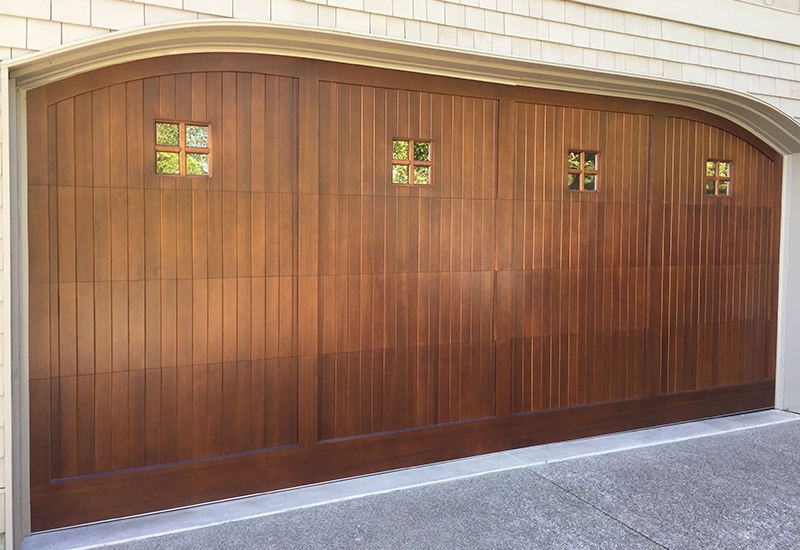
Traditional carriage-style doors, when detailed correctly in wood or wood-clad finishes, remain exactly right for traditional architecture and tend to age well.
Operator quality is also worth paying for. An inexpensive operator on an expensive door is a failure waiting to happen. Direct-drive units, jackshaft operators mounted to the side of the opening, and smart controls that integrate with the rest of the home are the standard specification in serious projects. They also free ceiling space for lifts and overhead planning.
The garage door should never be selected only from the outside. It has to be judged from the inside of the room as well. The interior panel finish, the tracks, the operators, the natural light, the sightlines, and any ceiling conflicts all affect the finished garage. A beautiful door that compromises the interior is only half solved.
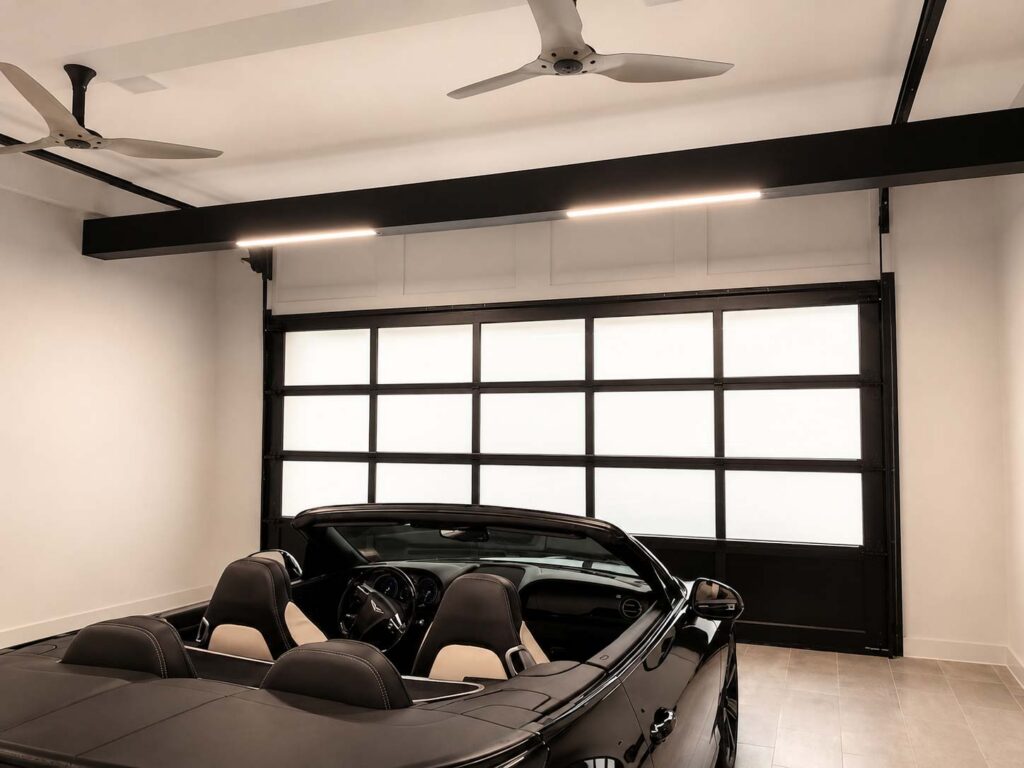
A glass garage door is both architecture and equipment. Judged from the inside, it should bring daylight in without compromising the ceiling plan, the lift clearance, or the sightlines of the room. A beautiful door selected only from the exterior is only half of a solved problem.
Budget: What a Luxury Garage Actually Costs
Clients and architects ask this early, and most published numbers in this category are misleading. For a fully furnished VAULT garage, meaning cabinetry, flooring, lighting, and the finishing details that make the room feel complete, projects typically start in the $100,000 range and rise from there. A full-wall cabinet system for an average two- or three-car garage averages around $30,000 on its own. Multi-car collector garages and larger, more ambitious projects routinely reach several hundred thousand dollars.
What drives cost, in descending order of impact, is the size of the room and vehicle count, the cabinetry specification, the floor, the systems, the lighting, and the door package. Polished concrete and tile over a properly prepared substrate costs meaningfully more than a floor coating. Dedicated climate control and upgraded electrical add real value, but they are still cost drivers.
A useful way to think about it: the furnishing of a luxury garage should generally fall in the range of ten to twenty percent of the standard to which the rest of the home was finished. If the house was built to a $500-per-square-foot interior standard, the garage should not be finished to a $50-per-square-foot standard. That mismatch is visible the moment you step into the room.
The mistake is thinking about budget only as a price question. It is also a decision-allocation question. Where should the money go first? Which decisions are permanent? Which items can be adjusted later? Which choices will affect the room every day? A serious budget conversation answers those questions before it becomes a quote.
Working With the Right Team
A luxury garage is built by a team. The architect sets the vision and the proportions. The interior designer carries the language of the house into the space. The builder translates all of it into something real. Each role is its own discipline, and the best ones are remarkable at what they do.
A garage specialist joins that team the same way a kitchen designer joins a kitchen project, a landscape architect joins a site plan, or a home technology consultant joins an AV specification. The garage has enough moving parts: ceiling heights and lift clearances, cabinet planning, electrical coordination, climate systems, floor loads, door operators, and the finish integration that makes the whole thing read as part of the house. Bringing in a specialist is not a comment on the rest of the team. It is how the best projects in every specialized room get built.
The value of a specialist is not that they know more about cabinets. It is that they understand how dozens of seemingly unrelated decisions influence one another. The right advice at the beginning of a project can prevent expensive revisions months later. That is why the planning phase consistently delivers the highest return of any part of the process.
VAULT was founded and is led by an ASID-credentialed interior designer, and the company treats the garage as an interior architecture solution rather than a storage solution. VAULT is not a replacement for the architect, the designer, or the builder on a project. We are a partner who extends the team’s expertise in a room that has become its own discipline. We are there early enough to influence the decisions that matter before they become expensive to change: ceiling height, electrical layout, slab preparation, wall planning, and the coordination between the finished garage and the rest of the home.
What to Do Next
If you are designing a new garage or furnishing one that was recently built, the most useful next step is a conversation about the program before finishes are finalized. Every decision covered in this guide, from ceiling height to cabinet color, from floor material to lighting design, benefits from early planning. The earlier the design conversation happens, the more options remain available, and the less expensive the project is to get right.
The purpose of a design consultation is not to choose cabinetry. It is to gain clarity before committing to decisions that become difficult or expensive to change. Whether you are building a new home, renovating an existing garage, or assembling the right design team, the earlier those conversations happen, the more options remain open.
VAULT’s cabinet design consultations are complimentary. A complete garage design is charged on an hourly rate basis.
A luxury garage is never defined by a single material, a cabinet system, or the value of the automobiles inside it. It is defined by the quality of the decisions that shaped it.
Every choice, from the proportions of the room to the placement of a single light fixture, contributes to an experience that either feels intentional or feels compromised. The best luxury garages rarely impress because they contain more. They impress because every decision supports the next. The proportions. The light. The quiet confidence of durable materials. The seamless transition from the home into the garage.
When every decision supports the next, the room no longer feels like a garage that was upgraded. It feels like it was always meant to be there.
The garage stops being the room the home forgot. It becomes part of the home.
A finished VAULT room is defined by what you do not notice. The proportions feel right before you can say why. The structure, materials, and light work together without competing for attention. Stone, timber, steel, and carefully chosen vintage signs become part of the architecture rather than decoration. Every decision in this guide exists in service of that moment, when the garage stops feeling like a garage and begins to feel like a room that always belonged with the home.
About the Author
Chad Haas is the founder of VAULT and the only interior designer credentialed by the American Society of Interior Designers (ASID) focused exclusively on luxury garage design. He has spent more than twenty years designing and furnishing high-end garages for homeowners, collectors, architects, and builders across the United States and Canada. VAULT is headquartered in Beaverton, Oregon, and serves clients worldwide.
Garage must-haves are usually defined by what you can see: cabinets, tools, workbenches, and storage systems. All of those matter. But some of the most valuable garage upgrades are the ones that quietly improve how the space works every day.
This article looks beyond the obvious and focuses on five often utility essentials homeowners should plan for early. These systems can make the garage cleaner, safer, easier to maintain, and more enjoyable to use.
Power where you need it. Air when tires are low. Water when something needs to be rinsed. A vacuum that can handle real garage messes. Battery maintenance for vehicles or equipment that sit unused for long periods.
These are the utility essentials that support a well-equipped garage.
The best garage is not filled with gadgets. It is planned so the things you use most often are ready, easy to reach, and not visually in the way. That is the difference between a garage that simply stores equipment and a garage that works like a complete room.
1. Garage Vacuum System
If every home garage should include one utility essential, this is it.
A wet/dry vacuum handles the messes a household vacuum was never designed for: sawdust, leaves, dust, dirt from floor mats, water near the garage door, small spills, and debris tracked in by vehicles.
For most homeowners, a quality wet/dry shop vacuum is the best starting point. It helps keep the garage from slowly becoming a dirty pass-through space.
Standard Approach: Portable Wet/Dry Shop Vacuum
A quality wet/dry shop vacuum handles sawdust, floor grit, tracked-in debris, and small liquid spills that a household vacuum was never designed for. It is one of the most-used tools in any working garage.
A compact, durable model like a RIDGID, Milwaukee or similar 5- to 8-gallon wet/dry vac typically runs $150 to $300 and can handle everyday garage cleanup.
The advantage is portability. The drawback is storage. These units are bulky, noisy, and need a dedicated place where they are not sitting in the middle of the garage.
In a Purpose-Built Garage
Central Vacuum or Wall-Mounted System
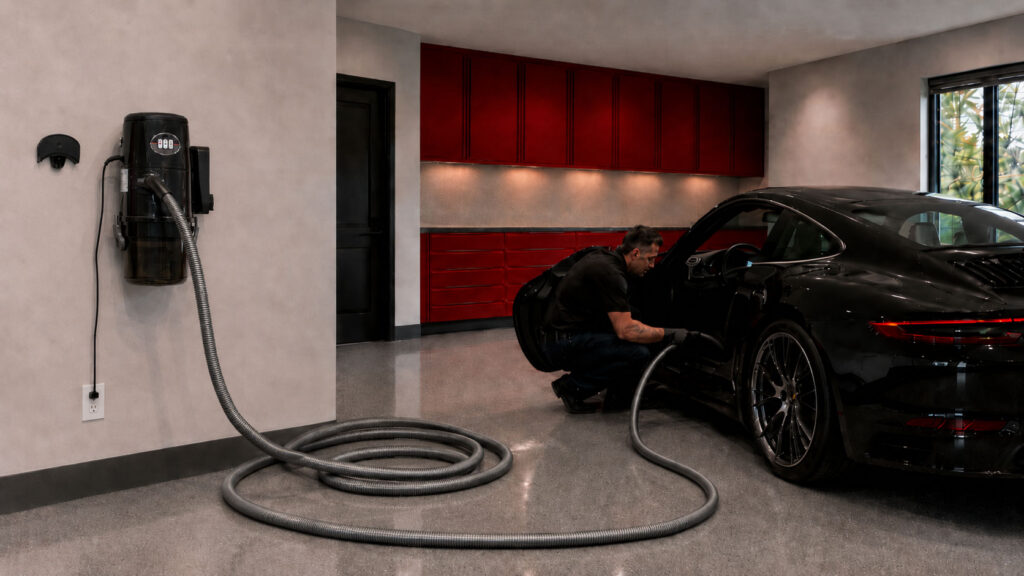
Higher-end garages benefit from a wall-mounted vacuum system or a central vacuum inlet with a long hose. A Griot’s Garage wall-mounted system with a 32-foot hose, or a central vacuum kit with a 30- to 50-foot reach, solves the biggest problem with shop vacs: they are bulky, noisy, and always seem to be in the wrong place. In a well-designed garage, the vacuum equipment can be concealed, the hose can be built in, and cleanup becomes as simple as opening a cabinet and pulling out the hose. The best time to plan for this is during the design or build phase, when hose access, cabinet placement, power, and wall locations can be integrated cleanly.
Estimated cost: $250 to $1,000, depending on the system and level of integration.
A central vacuum unit that is mounted on a wall or out of sight provides whole-garage suction through a fixed inlet and long hose. Unlike a portable shop vac, there is no bulky vacuum to drag around, store, or move from one side of the garage to the other.
Best Placement: Place the vacuum near the vehicle bay or inside a cabinet run, with hose access planned before installation. This keeps the system easy to reach without making it visually intrusive.
2. Air Compressor or Tire Inflator
Every garage should have a reliable way to inflate tires. That does not mean every homeowner needs a large air compressor. For many homes, a compact tire inflator is enough. But some form of air belongs in the garage because tire pressure is not optional maintenance.
The National Highway Traffic Safety Administration recommends checking tire pressure monthly and notes that tire pressure monitoring systems only alert you once a tire is already significantly underinflated. Regular checks still matter because underinflated tires are often difficult to spot by sight alone.
Standard Approach: Compact Tire Inflator and Accurate Gauge
A portable tire inflator paired with an accurate gauge covers the most common air needed in any home garage. Tire pressure monitoring systems only alert you when a tire is already significantly underinflated, so a monthly manual check still matters.
A portable tire inflator, such as a DeWalt or similar model, typically runs $40 to $100 and can be stored on a shelf. Paired with an accurate tire pressure gauge and kept near a convenient outlet, it handles basic tire maintenance for most homeowners.
The downside is convenience. If it is buried in a cabinet or stored far from the vehicle bay, you are less likely to use it regularly.
Upgraded Approach: Air Compressor with Hose Reel
For homeowners who work on their own vehicles or use air-powered tools, a larger compressor makes sense.
A 2- to 3-horsepower compressor, typically $300 to $600, provides consistent pressure for impact tools, nail guns, paint sprayers, and air ratchets. The real upgrade is running air access through the garage the same way you would plan electrical circuits.
An air hose reel with 30 to 50 feet of tubing gives you access to compressed air throughout the space without dragging loose hoses across the floor.
In a Purpose-Built Garage:
Fixed Compressor with In-Wall Air Lines and Noise Isolation
Serious garages plan the air system during construction. A fixed wall-mounted compressor with dedicated air lines run through the walls provides instant access to compressed air at multiple points in the garage, similar to a well-planned electrical layout. The compressor itself can be placed in an insulated enclosure or separate utility space to reduce noise, since compressors can be loud, often reaching 80 to 90 dB.
This type of setup typically costs $1,500 to $3,500, depending on the compressor, installation, air line layout, and enclosure. Quieter brands such as California Air Tools or Rolair are often better suited for this kind of integrated garage installation. Higher-end Pilot Air units typically range from about $2,000–$8,500, depending on model, tank size, and motor power.
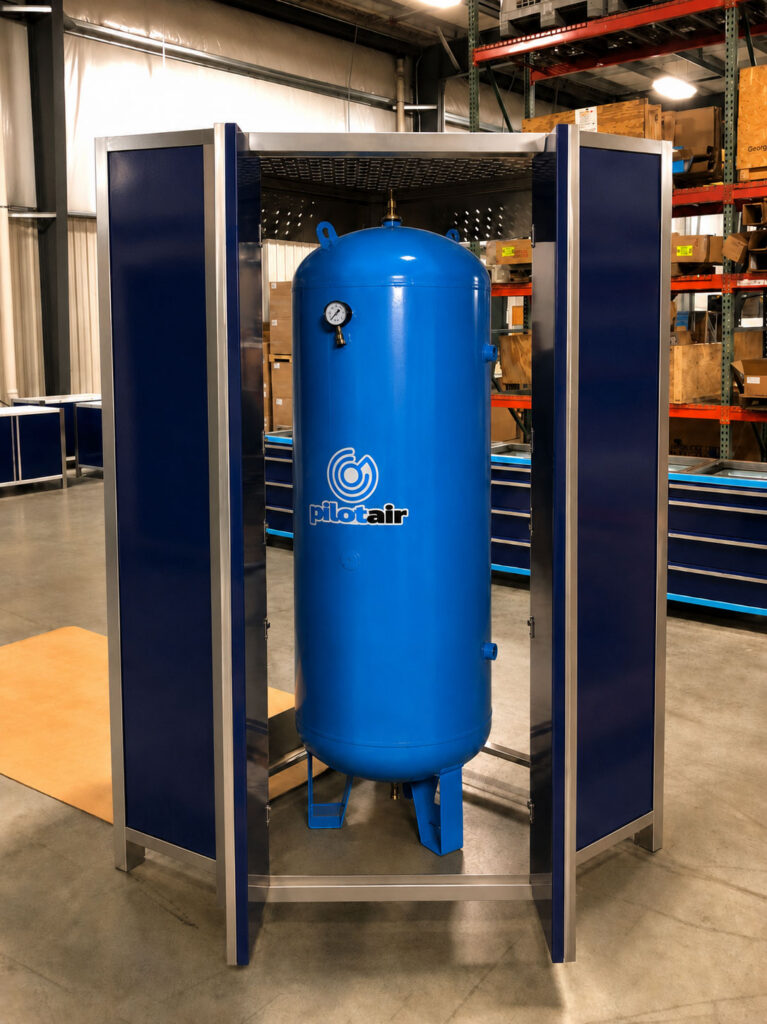
VAULT custom built this cabinet to house a client’s vertical air compressor tank and keep it completely out of sight. The interior was lined with sound-deadening material to make its operation run quieter. The result is a more elegant solution and a noticeably quieter garage than leaving the unit exposed.
Best placement: A portable inflator can be kept anywhere. What matters is convenience and access to power; most homeowners store it near the main vehicle bay for quick use. For a fixed system, locate the compressor in a dedicated utility area or insulated cabinet and run in-wall air lines so you can reach all four tires without moving the vehicle; also extend lines to any work zones for pneumatic tools. Because compressors can be loud, put fixed units in a separate room or a cabinet lined with acoustic foam to reduce noise.
3. Retractable Power Cord Reel
A garage without convenient power becomes frustrating fast. Most homeowners eventually need temporary power for a vacuum, charger, inflator, pressure washer, detailing light, fan, or tool. The mistake is letting loose extension cords become the long-term plan.
The Electrical Safety Foundation International warns against overloading extension cords, running them through water, or using them as permanent wiring. Heavy reliance on extension cords is often a sign that more outlets are needed. That is why a retractable cord reel belongs on the list. Used properly, it gives you temporary reach without leaving cords across the floor.
Standard Approach: Heavy-Duty Retractable Cord Reel
A retractable cord reel delivers power anywhere in the garage and rewinds cleanly when the job is done. Extension cords left on the floor are a trip hazard and are not rated for permanent use, so a wall-mounted reel is the right long-term solution.
A 50-foot retractable reel with automatic rewind, like a Southwire model, runs $60 to $120. Mount it on the wall above a work zone, plug it into a properly rated outlet, and you have power everywhere in the garage without trip hazards.
In a Purpose-Built Garage
Ceiling-Mounted or Cabinet-Integrated Reel with Dedicated Circuits
In a high-end garage, power is planned during the design phase. Dedicated circuits support the compressor, charging stations, task lighting, and temporary power. A ceiling-mounted or cabinet-integrated retractable reel, like a Hubbell or similar commercial-grade system, sits out of sight until needed. Multiple task outlets above counter height, dedicated circuits for battery chargers, and intentionally concealed power points near where work happens are all specified before drywall goes up.
Combined with an electrician’s coordination, this approach costs $2,000 to $5,000 but makes the garage feel designed, not jury-rigged. Cost is offset by not needing to see cords, reels, or power equipment when the space is not in use.
A ceiling-mounted retractable cord reel disappears when not in use and drops exactly where power is needed. In a designed garage, power infrastructure is planned before drywall, not added as an afterthought.
Best Placement: Above a work zone, near the front of a cabinet run, or centered where it can reach both the vehicle and workbench.
4. Hose Reel or Integrated Water Station
A hose reel is easy to overlook until the garage needs water.
A hose supports car washing, floor rinsing, garden work, pet cleanup, trash bin cleaning, and general household use. The question is not whether a hose is useful. The question is whether it stays clean, accessible, and out of the way.
Standard Approach: Wall-Mounted Hose Reel
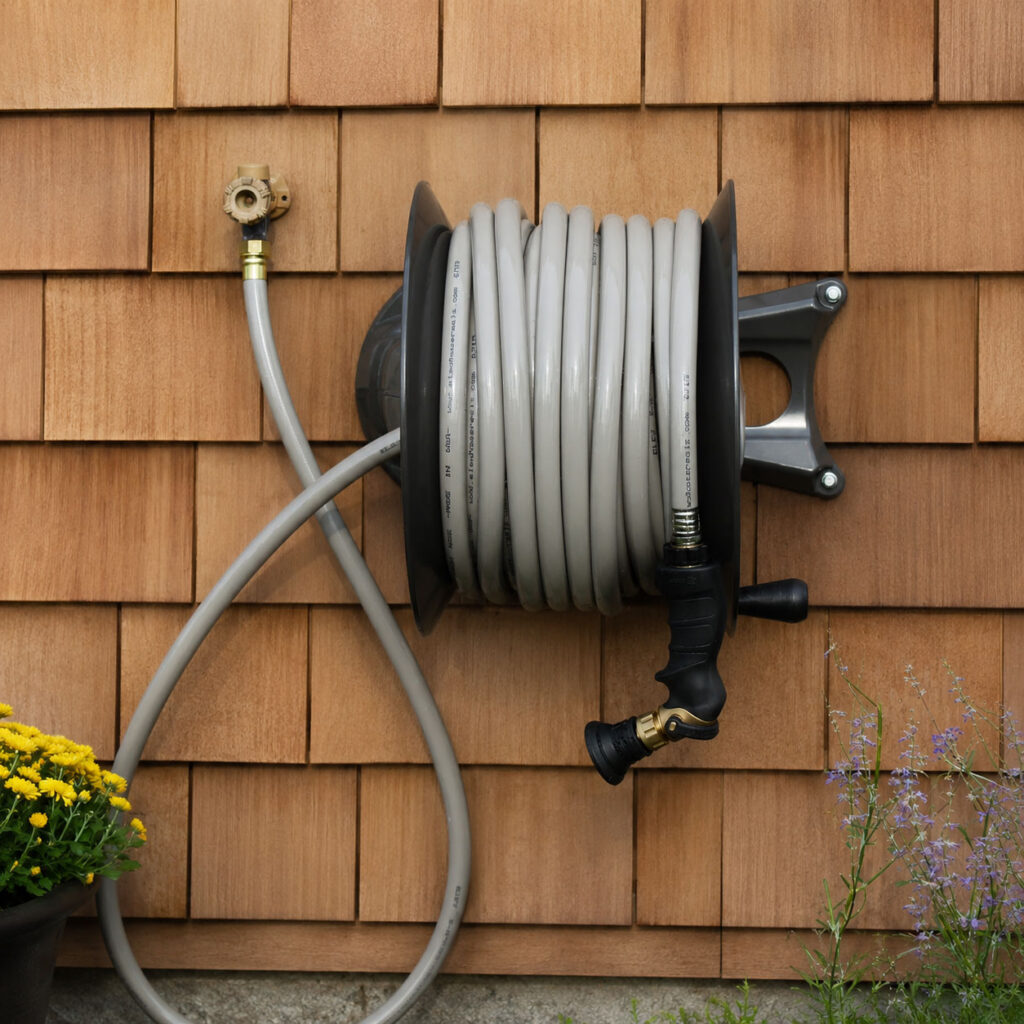
A wall-mounted hose reel keeps the hose coiled, protected, and ready without piling up on the garage floor. Positioned near the opening or a dedicated wash bay, it handles everything from car washing to floor rinsing with no untangling required.
A durable wall-mounted hose reel, such as an Eley or similar aluminum model with 50- to 75-foot capacity, typically runs $80 to $150 and solves the tangled-hose problem.
Mounted near the garage door or utility wall, it becomes the go-to solution for car washing, floor cleaning, and outdoor cleanup.
In a Purpose-Built Garage
Recessed or Architecturally Integrated Water Station
In a well-designed garage, the water station is planned into the room from the start. That means coordinating the hose bib location, drainage, wall protection, floor slope, and exterior water access. Some high-end installations include hot and cold water, a recessed or enclosed hose reel, and a finished wall panel behind the water area. When planned during construction, the plumbing can be built in cleanly instead of surface-mounted later.
A designer-integrated water station with dual-temperature water and drainage typically runs $1,500 to $3,000, depending on the layout and level of finish. It removes visual clutter and creates a dedicated utility zone that feels intentional, not improvised.
Best Placement: Place the hose reel near the garage opening, in a wash bay, or within a utility zone where water access will not interfere with cabinetry, storage, or vehicle display.
5. Battery Tender or Concealed Charging Station
A battery tender is not the most universal garage essential for every homeowner. But for the right homeowner, it can be one of the most important.
If the garage holds a collector car, weekend vehicle, motorcycle, ATV, golf cart, classic truck, seasonal equipment, or anything that sits unused for long periods, battery maintenance becomes part of protecting the investment.
Modern battery management is not just about charging. It is about maintaining, recovering, and extending battery life while keeping the garage clean and organized.
Standard Approach: Smart Battery Maintainer
A smart battery maintainer, such as a Battery Tender by Delran or CTEK or NOCO model, typically runs $80 to $150 and handles trickle charging, battery recovery, and long-term maintenance.
For a homeowner with a collector car, seasonal vehicle, or stored equipment, this can be essential. Most quality maintainers can stay plugged in for months without damaging the battery.
The downside is visual clutter. Chargers, cords, and leads can quickly make a finished garage look unfinished if they are not planned for.
In a Purpose-Built Garage
Concealed Charging Station Inside Cabinetry
In a luxury garage, battery maintenance should be built into the design. That may mean a dedicated outlet inside a cabinet near the collector vehicle, a labeled charging drawer, a cord pass-through, or a flush access point with concealed wiring. The goal is simple: the vehicle stays maintained, but the charger and cords stay out of sight. Some homeowners choose a dedicated charging bay with integrated cabinetry that houses the charger, organizes the cords, and keeps everything hidden when not in use.
A properly designed concealed charging station typically costs $400 to $800 to build into cabinetry, but it makes the entire garage feel more intentional.
A battery maintainer tucked inside a custom cabinet keeps collector vehicles on a maintenance charge year-round. The charger and leads stay completely out of sight, so the garage looks finished even when the car is plugged in.
Best Placement: Place the charging station near collector vehicles, inside cabinetry, or in a dedicated charging zone outside the main sightlines.
The Real Lesson: Plan the Garage Before You Fill It
The most useful garage essentials are not the flashiest. They are the systems that make the room work: cleaning, air, power, water, and battery maintenance. A homeowner can buy all five after the garage is finished. But the best result comes when they are planned before the room is complete.
That is the difference between equipment added later and a garage designed properly from the beginning.
In a basic garage, these essentials may sit on shelves, hang from hooks, or roll around the floor. In a designed garage, they should be integrated with the same thought given to cabinetry, lighting, flooring, and vehicle placement.
The goal is not to own more equipment. The goal is to make the garage easier to use every day, while keeping the room clean, composed, and worthy of the home.
Plan the utilities early. Hide what should disappear. Keep what you use within reach. That is how a garage starts to feel designed, not merely equipped.
About the Author
Chad Haas is the founder of VAULT and the only interior designer credentialed by the American Society of Interior Designers (ASID) focused exclusively on luxury garage design. He has spent more than twenty years designing and furnishing high-end garages for homeowners, collectors, architects, and builders across the United States and Canada. VAULT is headquartered in Beaverton, Oregon, and serves clients worldwide.
A Close Look at Forced Gas as an Option for Residential Garages
Keeping your garage warm and comfortable during the colder months can dramatically enhance the functionality and enjoyment of your space. There are several approaches to achieving a cozy environment—ranging from radiant in-floor systems to electric unit heaters. In this article, we’ll take a close look at forced-air gas heating units (often referred to simply as “gas heaters”) and explore why they’re frequently considered among the most practical and cost-effective choices for residential garages.
FORCED-AIR GAS HEATING FOR GARAGES Exploring How Forced-Air Gas Systems Work
At their core, forced-air gas heaters operate by drawing in cool air from the garage, passing it through a heat exchanger (which is heated by burning natural gas or propane), and then blowing the warmed air back into the garage. This convection-based process ensures that the entire space—rather than just the objects or surfaces—is heated effectively. Most forced-air gas heaters come with a blower fan and thermostat, allowing homeowners to set the exact temperature they desire.
Why Gas Is a Leading Choice:
1. Energy Efficiency and Operating Cost – In many regions, natural gas tends to be more affordable per unit of heat output (often measured in BTUs) compared to electricity. For this reason, gas can be a cost-effective choice, especially if you plan to keep your garage heated consistently or live in a cold climate.
2. Faster Heat Recovery – Because forced-air gas heaters quickly raise the ambient air temperature, you can go from a cold garage to a cozy workspace in a relatively short span of time. For individuals who use their garage intermittently (like weekend hobbyists), having rapid heat-up capability is a big plus.
3. Readily Available – If your home already has natural gas lines for appliances such as a furnace or water heater, installing a gas unit heater in your garage can be straightforward. Even in areas without natural gas service, propane is often a viable alternative.
UNDERSTANDING THE DIFFERENT TYPES OF FORCED-AIR GAS UNITS
When it comes to forced-air gas heaters, there are generally two main categories, both of which function similarly but differ in how they handle airflow for combustion:
Standard Combustion (Open) Units
How They Work: These heaters draw the combustion air (the air needed to burn the gas) directly from inside the garage. They then exhaust the combustion byproducts (often referred to as flue gases) through a dedicated vent pipe going either through the roof or a side wall.
Key Considerations: If you occasionally cut wood, paint, or work on projects that produce dust, fumes, or other particulates, the burner assembly can accumulate debris over time. Proper maintenance and periodic cleaning can help prolong the life of the heater.
Sealed (Separated) Combustion Units
How They Work: These systems draw combustion air directly from outside through a dedicated intake pipe and then send exhaust gases back outside through another pipe. This design isolates the burner from the air inside the garage.
Key Considerations: Because dust or fumes in the garage cannot be drawn into the heater’s combustion chamber, this style is generally recommended if you regularly create sawdust or chemical fumes. While typically more expensive, sealed combustion units can deliver a longer heater lifespan in “messier” garage environments.
BENEFITS OF FORCED-AIR GAS HEATING
Quick and Uniform Heating – Forced-air gas units excel at rapidly warming the air. This uniform distribution of warm air helps eliminate cold spots and ensures that no matter where you’re working—or where vehicles are parked—the temperature is relatively consistent throughout the garage.
Thermostat Control – Modern gas heaters allow you to set your desired temperature with a simple thermostat. This ensures the heater cycles on and off automatically, maintaining a steady garage climate without manual intervention.
Flexible Installation Options – Forced-air gas heaters typically mount near the ceiling in one of the corners of your garage. The venting can run either vertically (through the roof) or horizontally (through an exterior side wall), offering flexibility based on your architectural constraints and aesthetic preferences.
Affordability – Although installation costs can vary, forced-air gas heaters are often more budget-friendly than installing a full in-floor radiant system—particularly in existing garage spaces. The recurring operational costs can also be lower than many electric solutions in regions where natural gas is less expensive.
NOISE AND APPEARANCE
While forced-air gas heaters do rely on a blower fan, most residential units are designed to minimize noise through improved fan blade designs and resilient motor mounts. Still, there will be a gentle hum when the fan kicks on. From an appearance standpoint, gas heaters are modest in size and sit up near the ceiling, leaving most of your wall space free.
SAFETY AND VENTING CONSIDERATIONS
Ventilation Requirements – Forced-air gas units require an exhaust vent to remove combustion byproducts, such as carbon monoxide. Local building codes typically dictate proper venting clearances and acceptable run lengths for horizontal or vertical installations.
Fire and Clearance – Just as you do with a gas furnace inside your home, maintaining proper clearance around the unit is crucial. Most manufacturers provide guidelines on how close combustible materials (like stored items, cars, cabinets or shelving) can be to the heater and venting.
Thermostat Settings – Garage heaters can absolutely be left on a thermostat safely, just like a home furnace. That said, many people opt to keep their garage at a lower “holding” temperature (e.g., 50°F) and only turn it higher when they plan to spend time in the garage.
INSTALLING AND SIZING A FORCED-AIR GAS HEATER
Heat Load Calculation – Before purchasing a gas heater, it’s wise to consult a licensed HVAC professional who can perform a heat-loss calculation. This takes into account your garage size, local climate, insulation, door and window types, and how warm you want the space. Proper sizing ensures you neither undershoot nor overshoot your actual heating needs.
Placement and Aiming – In many cases, installers prefer to position the heater so it can blow warm air toward the garage door—an area prone to higher heat loss. By directing the warm airflow across the largest expanse of the garage, you reduce cold spots and help offset any drafts that occur when the door is opened.
Piping and Fuel Supply – You’ll need a gas line routed to the unit. Whether you’re running natural gas or propane, coordinate with both an HVAC specialist and—if needed—a licensed professional can ensure your installation meets building codes.
Thermostat Location – Consider not placing the thermostat right next to the heater or any drafty door. A well-considered thermostat location promotes more consistent temperature readings and better comfort control.
COST OF FORCED-AIR GAS HEATING
The cost of installing a forced-air gas unit in your garage is highly dependent on:
Whether you have easy access to a gas line
Venting complexity (i.e., short side-wall run vs. a long roof run)
Local labor rates
Specific unit features (e.g., sealed combustion vs. open combustion)
Once installed, ongoing expenses for natural gas (or propane) will determine your monthly operational costs. In many cold-weather regions, homeowners find that the combination of reliable warmth and manageable gas bills makes these units well worth the investment.
FINAL TAKEAWAYS
Forced-air gas heaters offer a balanced combination of quick heat, affordability, and ease of use—particularly in garages where installing a complex hydronic system or relying solely on electric heat might be too costly or impractical. As with any heating choice, weigh your priorities: long-term operating costs, climate factors, how you use your garage, and the size of your space.
A properly selected and professionally installed forced-air gas unit can transform your chilly garage into a comfortable workshop, hobby area, or simply a more inviting space to park your car. If you’re seeking a proven, straightforward, and powerful heating method, a forced-air gas heater is certainly an option worth considering.
This article was written by Chad Haas, who has accumulated over two decades of experience designing and furnishing luxury garages all over the world. As the founder of VAULT and the only ASID Garage Designer in the world, Haas offers a unique insight into this specialized field.
When crafted with care and detail, a garage surpasses its conventional role of simple storage to be a collector’s haven—a place to entertain, luxuriate, and more.
By Marlene Ridgway
Long before the pandemic, homeowners were unleashing their creativity upon their garages, transforming them into epicenters of luxury and style to expand living space. With the flair of a seasoned architect and some fresh ideas, your garage becomes more than the ultimate display case for your vintage or modern cars— it morphs into a jaw-dropping spectacle, an enviable entertainer’s dreamscape, or even a lavish home office. Picture turntables offering panoramic 360-degree views of your prized automobiles, opulent wine displays, captivating art installations, and more, pushing high-end home garages into a league of their own.
FANTASTIC FEATURES
The turntable has become a favorite attribute among car collectors and auto enthusiasts. “It’s not just practical for maneuvering cars, but it also transforms the garage into a showroom, giving each car its moment in the spotlight,” says Michael Vincent, CEO and president at Berkshire Hathaway HomeServices Portugal Property. A rotating platform alone can elevate your car collection while adding the right lighting and decor, such as framed instruments, vintage signs, and other relished items, will complete the overall look. Vincent adds that the turntables and luxury garages, “cater to car enthusiasts who see their collection as an art form. It’s a functional space that doubles as a personal gallery.”
Wine displays have also become an element that homeowners value in elevated garages. Sommi Custom Wine Cellars, a company based in Portland, Oregon, specializes in converting garage space and more into wine storage that is not only functional but also aesthetically turns heads. These displays are a bold statement with elegant designs, especially against the backdrop of luxury sports cars and other collections.
MAKING THE MOST OF GARAGE SPACE
More luxury living space to enjoy is always a sought-after element. It’s no surprise to find that multifunctional garages in high-end real estate are becoming more popular. Everything from lavish lounge/bar areas and game rooms to sophisticated studies and luxe libraries have a place among car collections.
In fact, the whole premise of Garage Deluxe, a company dedicated to creating luxury spaces for unforgettable automobiles, is to offer much more than storage. “It is all about the enjoyment of your car collection by combining it with leisure spaces, for example, a home office, gymnasium, a sunken seating area with a cinema screen, a bar area, et cetera,” says Jonathan Clark, the founder of Garage Deluxe, which is under the parent company Jonathan Clark Architects—an award-winning RIBA Chartered Practice. “This way you can view and appreciate your cars on a daily basis whether privately or with friends and colleagues.”
The often larger space and high ceilings in the garage make prominently displaying art and other collections a simple feat. The look and feel of an art gallery becomes possible in the vast rooms, and the cars often serve as the artful centerpiece of the show.
GARAGES ON ANOTHER LEVEL
Chad Haas refers to himself as the ‘Chief Gearhead’ at his company, VAULT, which prides itself on crafting functional—as well as breathtaking—luxury garages. With more than 20 years of experience, Haas makes note of a new trend that’s becoming more common among serious car collectors. “With restrictions on lot sizes and limits on garage dimensions, it’s getting tougher to make room for car collections at home. This is why car condos are becoming more popular,” Haas says when asked about what’s trending in the world of garages. “People need that extra space for their collections, and an area where they can also work or entertain.”
Clients who don’t have the space or run into restrictions when expanding are choosing to build garages on land that’s separate from their homes. Haas adds, “These structures may look like warehouses from the outside, but inside, they are impressively furnished,” often with the finest luxury car collections.
QUESTION AND ANSWER SESSION WITH VAULT FOUNDER CHAD HAAS CONTINUED
Question #1: What is your favorite part of designing luxury garages?
“What I enjoy most about designing and furnishing garages is connecting with my clients. Witnessing their awe at the project’s completion is incredibly rewarding, especially when they see possibilities they never imagined. Conceiving unique designs from my imagination and having my work appreciated brings me the greatest joy.”
Question #2: What are some of the challenges when it comes to designing garages?
“Each project presents its own unique challenges. The most common obstacle I encounter is the need to rework existing structures due to inadequate planning during the initial design and construction phases. Often, I find elements like plumbing, electrical components, and appliances placed haphazardly, without consideration for their impact on the space’s functionality. My role is to streamline and simplify the design, creating a timeless, beautiful, and efficient space that makes the best use of every inch.”
Question #3: Is there a particular project that you’ve worked on that stands out?
“One project that stands out involved a client who was unsatisfied with the ideas proposed for his dream home by his architect and interior designer. He felt frustrated by the generic ideas and off-the-shelf products suggested by other professionals and needed someone who specialized in garages, so he found me online and brought me on board. After we finished the project, he called me, emotional and deeply grateful for the uniquely personalized garage I’d designed for him, which included themes that reminded him of his father, his son, and his journey as an entrepreneur. He told me it was his favorite room in the entire house, which, given the grandeur of his residence, was an enormous compliment. It was a heartfelt moment I’ll never forget.”
Question #4: What are some unexpected ways to utilize a garage that some customers might not think of?
“With restrictions on lot sizes and limits on garage dimensions, fitting car collections into average-sized garages can be challenging, which is the why car condos are gaining popularity—they provide extra space for collections and areas for work or entertaining. I’ve been engaged by developers to contribute to their design and by individual condo owners to furnish them.
Some clients are also choosing to build garages on land separate from their homes. These structures may look like warehouses from the outside, but inside, they are impressively furnished.”
Finding the ideal heating solution to keep your garage comfortable and inviting during chilly months can be a rewarding endeavor. Selecting the perfect heating system for your garage entails navigating through a myriad of options, ranging from forced-air (both gas and electric) to in-floor radiant heating (electric and hydronic). With such a diverse array of choices available, the challenge lies in determining which system best meets your specific needs, requirements, and budget.
To assist you with determining what are the optimal garage heating solutions, I will delve into each option with precision. In this article, I will guide you through the diverse array of Radiant In-Floor systems available for installation in your garage and tackle Forced Air options in our next article.
IN-FLOOR RADIANT HEATING
Exploring the Benefits of a Radiant Floor Heating Systems for Your Residential Home Garage
An alluring and efficient option well worth exploring is an in-floor radiant heating system. There are two types of radiant heating: Hydronic and Electric.
Hydronic (Liquid) RADIANT HEATING – Hydronic radiant heating systems utilize hot water flowing through pipes installed within the floor to distribute heat evenly throughout a space. Here’s how hydronic radiant heat typically works:
Boiler or Water Heater: A central boiler or water heater heats water to the desired temperature. Typical heat sources for hydronic radiant heating systems include gas- or oil-fired boilers, electrical, wood-fired boilers, solar water heaters, or a hybrid combination of these options. Hydronic systems typically can be more expensive than electric radiant heat due to the need for a boiler or water heater.
Piping Network: Pipes, usually made of PEX (cross-linked polyethylene) or similar materials, are installed within the floor embedded into the concrete slab.
Heat Distribution: As hot water circulates through the pipes, it radiates heat upwards, warming the floor surface and the room above it.
Thermostat Control: The system is controlled by a thermostat, allowing users to regulate the temperature to their comfort level.
ELECTRIC RADIANT HEATING – Electric radiant heating systems utilize electric resistance cables or mats installed beneath the floor surface to generate heat. Here’s how electric radiant heat typically works:
Heating Elements: Electric cables or mats, typically made of materials like resistance wire or carbon film, are installed beneath the garage floor surface to produce heat.
Electricity Supply: When electricity flows through these heating elements, they generate heat, warming the floor above them; whereas the hydronic liquid system differs in heating water in a boiler and circulating it through tubing beneath the floor to emit heat.
Heat Distribution: Like hydronic systems, electric radiant heating radiates heat upwards, providing warmth to the room.
Thermostat Control: The system is controlled by a thermostat, enabling users to adjust the temperature according to their preferences.
Electric systems tend to have simpler installation processes and may be more suitable for smaller areas or where access to a boiler or gas line is limited. However, liquid systems are often preferred for larger spaces or where energy costs are a concern, as they can be more energy-efficient over time.
Advantages of Radiant Heating
Efficient Heat Distribution – Since heat radiates from the entire floor surface, radiant heating systems provide uniform warmth throughout garage. Unlike conventional forced-air heating systems that rely on blowing heated air through vents, radiant systems evenly distribute heat, eliminating cold spots and ensuring a consistent, cozy temperature throughout the garage.
Quiet Operation – Radiant flooring systems are known for their quiet operation. Unlike noisy blowers and fans associated with forced-air systems, a radiant flooring system operates silently. This is particularly advantageous in a garage setting, where you might want a peaceful atmosphere for working, tinkering on projects, or simply enjoying your hobby without the distraction of a heater blowing in the background.
An Invisible Installation – Radiant systems are practically invisible, as the heating elements are hidden beneath the floor. This enhances the aesthetic appeal of your garage, allowing you to focus on the layout and design of the space without having to work around bulky heaters or vents. This not only maximizes the use of space but also eliminates the need for visible heating equipment, many of which are unsightly, that could interfere with your garage layout or aesthetics.
Energy Efficiency in their Operation – Radiant flooring systems are known for their energy efficiency. Hydronic heating systems, in particular, which takes advantage of water’s excellent heat conductivity (water conducts heat more effectively than air) allows for better retention and even distribution of heat, resulting in lower energy consumption compared to some other heating methods.
Reduced Air Circulation has Benefits – Traditional heating systems can stir up dust and allergens as they blow air through vents. In contrast, radiant heating systems do not rely on air circulation, reducing the potential for dust to be spread around the garage. This can be particularly beneficial if you use your garage as a workshop or storage space for sensitive items, like collector cars.
COST OF RADIANT GARAGE FLOORS
The cost of installing a radiant heating system for garage floors varies based on factors such as location, the size of your garage, installation type (hydronic or electric), floor covering (polished concrete, tile, floor coating or interlocking tiles), and local labor costs. Radiant heating system can potentially entail significant upfront costs due to initial equipment installation and complexities like zone valves and intricate piping and a more involved installation process compared to alternative methods.
Summary of In-Floor Radiant Heating Systems
Radiant flooring systems, whether hydronic or electric, offer unparalleled efficiency and tranquility for spaces like residential garages. Radiant floor heating transforms your garage into an aesthetically pleasing, comfortable, and inviting space by prioritizing consistent heat distribution and eliminating allergen circulation from air movement. This system embodies efficient energy utilization, even heat dispersion, and elevated comfort, making it ideal for those seeking optimal warmth and functionality in their garage.
The choice between the two depends on factors such as installation preferences, budget, and energy considerations. Before making a decision, it’s advisable to consult with heating experts who can assess your garage’s specific requirements and guide you toward the best heating solution for your needs.
[This article was written by Chad Haas, who has accumulated over two decades of experience designing and furnishing luxury garages all over the world. As the founder of VAULT and the only ASID Garage Designer in the world, Haas offers a unique insight into this specialized field.]
Homeowners are increasingly recognizing the value and convenience of having access to a water source in their garage. This trend is gaining popularity as it offers easy access for a range of tasks. These tasks include handwashing, cleaning components, bathing pets, washing vehicles, and even having a bar sink in luxury garages designed for entertainment purposes.
When deciding on optimal plumbing placements within a residential garage, it’s important to take into account the following essential factors for positioning the plumbing. This ensures both convenience and functionality while adhering to building codes:
Proximity of the Water Source to Tasks and Needs
The water source in the garage should be strategically positioned and easily accessible for homeowners, enhancing both convenience and efficiency. Placing plumbing close to areas where tasks like handwashing, parts cleaning, vehicle washing, and entertaining are performed ensures access to water is convenient and efficient.
Consider placing a sink or spigot near a garage exit, main garage door, or entrance. This strategic positioning guarantees effortless access and, if a hose is being used, reduces the requirement for excessive hose length, which could potentially present a tripping hazard.
Proximity to Water Supply Lines
In new construction, placing a water source that is nearest to plumbing lines is generally more practical and cost-effective, as it reduces the need for extensive plumbing installations. In remodeling projects, leveraging the proximity to existing plumbing, you can minimize the effort and expenses associated with plumbing connections.
Height Off the Floor
The placement of a plumbing spigot, such as a hose bib or outdoor faucet, should be determined based on installation requirements, local codes, and practical considerations for the intended use.
Space Availability
When selecting a location for the sink in your garage, prioritize a spot that doesn’t block pathways or disrupt other garage activities. Because corners can provide a challenge for storage due to limited accessibility, utilizing a corner cabinet, which already has space constraints, can be an excellent option for placing a garage sink while effectively concealing the plumbing.
Hot Water Line
You may want to consider plumbing a hot water line to mix the water to a more comfortable temperature should you need warmer water to bathe your dog, wash your hands or clean stubborn stains or parts.
Water Quality
If detailing your automobile is a passion and your water is hard, you may want to consider an in-line water softener and deionizer to remove the minerals from your tap water so you can rinse your car and dry it off without your glass and paint spotting.
If your water source is being used to make ice or as a bar sink it should be clean and safe for human consumption. It is important to test the water quality regularly to ensure that it meets local health and safety standards.
Insulation
In cold climates, it’s important to properly insulate the water source and plumbing to prevent freezing and bursting pipes. This will protect the system and ensure its longevity.
In conclusion, whether you’re giving your dog a bath, washing your hands, cleaning your car or enjoying your garage bar, a well-placed water source simplifies tasks, making your garage an efficient and more enjoyable space.
In the world of luxury car detailing, attention to detail is paramount. Every aspect of the customer experience must exude elegance, precision, and trust. When it comes to storing and organizing their tools and equipment, ESOTERIC, a leading luxury car detailing company, understands the importance of choosing the right storage solution. That’s why ESOTERIC was compelled to partner with VAULT®, a renowned provider of high-quality metal cabinets. In this article, we will explore why ESOTERIC has selected VAULT® to meet their storage needs and how these metal cabinets help create a lasting impression on their esteemed clientele.
As clients entrust their prized possessions to ESOTERIC for meticulous detailing, it was crucial to create an environment that not only reflects the luxury of the vehicles themselves and instilled confidence in their customers. The first impression is often the lasting one, and ESOTERIC’s Founder Todd Cooperider understood the significance of this moment. A clean, organized, and visually appealing workspace plays a pivotal role in establishing ESOTERIC’s reputation as a premium service provider.
“We are a very high-end luxury detailing and protection facility, we have cars shipped into us from all over the country for paint correction polishing, paint protection film, ceramic coating, window tint, customization … because they are looking for the best of the best in the services, in the quality, and in customer experience that they get. The funny thing is they had a customer at one point who said that they were from out of state, and they looked at pictures of the shop and they said even without seeing your work, ‘any place that can have a really clean facility with white cabinets and white floors that Is where I want my car to go to’, explained Cooperider.
Image of the ultra-rare McLaren Sabre from the Triple F Collection, a highly exclusive vehicle with only 15 in existence. Esoteric performs meticulous paint correction and ceramic coating on the carbon fiber body, preserving its beauty and integrity.
Tailored Solutions for Efficient Organization
Efficiency and organization are crucial for a luxury car detail company like ESOTERIC. VAULT® Founder Chad Haas listened carefully to their requirements to personalize a custom storage solution tailored to their specific needs. With a wide range of cabinet sizes, configurations, and accessories, VAULT®’s optimized their workspace to ensure easy access to tools and supplies, enhancing their operational efficiency and streamlining their workflow. This level of organization not only saves time but also showcases ESOTERIC’s professionalism to clients.
Image of ESOTERIC detailing a Porsche 918 Spyder in their luxury car detail shop furnished with VAULT’s high-quality metal cabinets
Seeking Out Uncompromising Quality and Durability
When it came to storage cabinets, ESOTERIC sought out a partner who shared their commitment to quality and durability. VAULT® stood out as the ideal choice for the impeccable reputation they built for crafting metal cabinets of exceptional craftsmanship. Utilizing the finest materials and manufacturing techniques to handcraft cabinets that are built to last a lifetime of use, ESORTERIC’s founder could rest assured that his investment in VAULT® metal cabinets would withstand the test of time and deliver reliable performance, even in a demanding environment.
“Looking closely at your product, (VAULT®) cabinets were built in such a way that we knew that they were going to be around for a long time and take on a lot of use and abuse while also providing us with that high-end luxury look that we were going for. We have had them in our facility here for just about 11-12 years now and they are holding up fantastic. We have had zero issues with them throughout this whole time despite the fact that we have 25 or so employees working in here using each and every one of them (cabinets) every single day. VAULT® has been fantastic for us, for sure” said Cooperider.
For luxury car detail companies like ESOTERIC, the choice of storage solutions goes beyond mere functionality. VAULT® metal cabinets have proven to be the ideal choice for ESOTERIC’s storage needs, combining durability, efficiency, and aesthetics. By selecting VAULT®, ESOTERIC not only ensures the efficient and safe storage of their tools but also creates an impressive environment that instills trust and confidence in their discerning clientele. Using VAULT® metal cabinets, ESOTERIC maintains the highest standard of excellence in the luxury car detailing industry.
Windows are becoming increasingly popular in garage design. They provide a pleasant source of ambient light and, if they open, a source for fresh air and ventilation. Windows can take advantage of a great view outdoors and connect the interior space with the outside providing a sense of openness in a way that can make the garage appear and feel larger than its actual size. Having a window over a work area can create a more pleasant and more interesting working environment. And if there is enough natural light coming into a garage, you may not even need to turn on the lights to grab what you need (speaking as someone who has accidentally left the lights on in his garage on more than a few occasions).
For architects designing a garage and the builders who build them, the location of windows, their size and orientation should be taken into consideration so that they do not limit the homeowners’ choices of what they may want to do. Depending on which direction the garage faces, you can still enjoy the daylight and views that a window brings if you are selective about where you locate them.
HEIGHT OF WINDOW FROM THE FLOOR
The height of a window off the floor is one of the most important considerations so they do not limit how that area of the garage may be used. All too frequently we run into challenges from windows that are specified too close to the floor, which can prevent cabinets from being used on that wall.
In a home, windows are traditionally set above the common height of 3 Feet (36”) measured from the floor to the bottom of the window trim to allow the placement of furniture under the sill and not block the window. Yet, we have encountered windows in garages that are placed below the standard height, which then creates an obstacle for the homeowner to place cabinets, storage racks, appliances, or other items that are more frequently being placed inside a garage.
If you place a window and its trim above countertop height, it will not block anything you may want to place in that area of the garage. Window trim can range from ¾” thickness to 3-1/2” or more, which should be accounted for in their placement measured from the floor to the bottom of the trim.
The safe zone that architects and builders should adhere to when designing and placing windows is to set them at least 36” and taller, as measured from the floor to the bottom of the window trim, and taking into account the window trim so that it is not set so closely to the countertop that it looks scrunched. Some homeowners may also want to set their countertops higher than the industry standard height than exist in kitchens, so it is not uncommon for countertop heights in garages to be set at a height of 38” or taller overall.
WINDOW ORIENTATION
Sun windows can fill the garage with bright, ambient light, just be aware of the potential for overheating in summer or incoming ultraviolet light causing fading to the paint on automobiles. If you are concerned about excessive heat or faded furnishings, making accommodations for blinds or a window film to block out the heat from the sun can help enhance the comfort of your garage.
WINDOW LOCATION
If you are concerned about privacy or security, the placement of a window in a location where it is not directly seen by prying eyes or at a height off the ground that a person could not climb through with the use of a ladder, will reduce the vulnerability of your garage to break-ins and theft. The size and shape of a window can also reduce break-ins if an average person cannot reasonably fit through them.
If you desire natural light, but you are concerned that outsiders will be able to look inside your garage, a simple solution of using privacy glass (like frosted glass) or installation of a film over the windows, as is commonly used in bathrooms, will ensure your privacy.
NUMBER OF WINDOWS
Keep in mind that the more windows that are placed in a garage the less wall space will be available for storage. However, if you have tall ceilings, placing windows near the ceiling can introduce ambient light and not conflict with anything you may want to do on the walls.
WINDOWS IN GARAGE DOORS
Another way to introduce natural light into a garage is specifying windows in your garage doors. In addition to increasing the curb appeal of your home by making the garage door more stylish, you will gain beautiful ambient light. In my home, I designed both wood carriage doors using seedy glass, which is an elegant and beautiful way to allow natural light to bathe my garages while retaining privacy. Even small lites, like on the carriage doors I designed for a garage remodel (see pictures below) allows just natural light to filter into the garage while also maintaining the privacy that was important to my client.
Hope you enjoyed reading this article and it helps you plan a better garage for your home.
“Cabinets look amazing. Seriously amazing!!! Attention to detail is over the top. Truly works of art. Your packing alone rivals Apple.”
Sometimes our customers just say it best. We recently received this glowing testimonial from a project in Colorado Springs – and rather than summarize it we figured we’d just share Dr. Christopher Jones’ kind words in its entirety. We collaborated with Prismatic Powders on this job to match our Professional Series Garage Cabinets to Christopher’s Porsches.
I have been an automobile, and Porsche enthusiast ever since I was a young boy. The first time that I saw a 930 Turbo I was in awe. The sexy lines, massive wing and the muscular rear end got my blood flowing. I could only dream of being able to drive such a car one day. After years of school and working hard, I attained my dream and have been fortunate enough to be able to own a few of these engineering marvels.
Next came Ferris Bueller’s Day Off and Cameron’s father’s garage. The glass on both sides allowing you to see through it was completely off the hook. For years, I dreamt of building “my garage/man cave”. The design would certainly have the glass on both sides allowing you to see the cars, and an awesome view out the back. After many years, this dream was finally materializing. I wanted it to have a real cool factor. As I started to work on the interior design, I did an incredible amount of research on everything from wall coverings, cases for my model car collection, floor coverings and cabinets. At first I did not think of the cabinets as a center piece, but still wanted them to be cool.
After looking at countless cabinets and cabinet companies online, I stumbled across VAULT®. These cabinets were beautiful! I looked through the gallery on VAULT®’s website a hundred times and decided this is what my garage needed. The first time I called VAULT® I got the owner, Chad Haas, on the line. We spoke for over an hour about his cabinets and what makes them unique. His enthusiasm and understanding of what makes a garage special was obvious. We hung up the phone and I emailed him a few photos of my Porsches and what I was planning for cabinets. The color choice was slate gray. I thought it would look clean and sharp. Chad saw the pictures of my cars and immediately said that we have to make the cabinets a custom blue to match my cars (Mexico Blue and Riviera Blue). At first I wasn’t sure about this choice. I thought that it may be too much. Thankfully, I listened and the color turned out to be beautiful!
When I first learned the price of these cabinets, I have to admit that I was a bit apprehensive. There are quite a few cheaper options out there, but after seeing the quality of engineering, materials and paint, there is no doubt that they are worth every penny. Granted you may save 25% by going with a cheaper option, but you will not get VAULT® garage cabinets! I have cabinets in my other garage that were made from melamine. These cabinets are functional, attractive and custom made. However, even after just a few years, the hinges are starting to fail. Most importantly, they are “just cabinets”.
The customer requested the integration of a subzero beverage fridge.
Then came the design stage. I wanted a specific setup for my hangout area that would incorporate a stereo cabinet and a sub zero fridge. Chad and his team went to work designing two custom cabinets to match my requested set up. I didn’t know this at the time, but they have never made a cabinet with an incorporated subzero beverage fridge. When they reached out to subzero, subzero told them that no one has ever re-faced one of their fridges with a metal front. VAULT® saw this as a challenge. They ordered the fridge of my choice and went to work designing a custom cabinet. We went back and forth a half dozen times with engineering drawings until they got what I wanted. They engineered everything from vented rear cabinet walls to accommodate the heat of the audio equipment, to a specifically located cut out to match my wall outlets. There were some challenges along the way, but after several iterations, they nailed it.
When it was time to ship my garage cabinets, they packaged them into bomb proof crates to protect them on their journey. Chad communicated with me the whole time and called me immediately after delivery to make sure that everything went smoothly. VAULT® provided detailed instructions on how to unpack and set up the cabinets. While this did require a fair amount of work, the instructions were spot on and made it a smooth process.
The cabinets exceeded my expectations in every way. When I started this process, the cabinets were not a primary concern or center piece of my garage. Now, I could not imagine my garage without the VAULT® cabinets. They MAKE the garage special! I look at them as a piece of art to be admired. The color is stunning! The construction is exacting!
Thank you Chad and The VAULT® Team for helping make my dream garage A Dream!